Available in your clinic
Not available in your clinic
Face treatments
Body treatments
Med Spa
Tightening & Lifting Treatment
Ultherapy is a leading non-invasive treatment licensed by Health Canada that lifts, tightens and firms the skin without surgery. Backed by 88 patents and 46 clinical studies, Ultherapy has earned a strong international reputation, particularly among specialists in plastic and aesthetic medicine. It is also the most popular corrective procedure at Dermapure, with visible results typically appearing within 6 to 12 months after treatment.
Each person is unique and may react differently to the proposed treatment. Images are for illustrative purposes only. They do not constitute a guarantee of results. Images provided by Ulthera
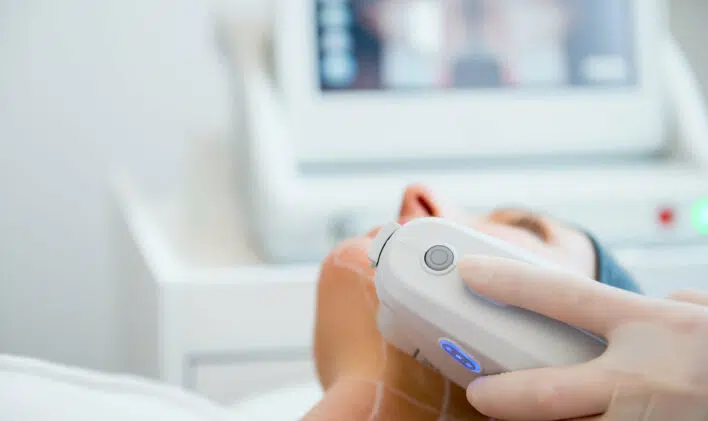
Ultherapy is a non-invasive treatment that uses focused ultrasound technology to support natural skin tightening. Available in select Dermapure clinics across Toronto, it is especially valued for its gradual lifting effect on the face, neck, and décolleté.
During the session, ultrasound energy is delivered through a handheld device and concentrated at various subcutaneous depths. Thousands of micro points are created in the skin’s support structures, triggering tissue regeneration while leaving the surface layer intact.
Ultherapy reaches depths of 1.5 mm, 3 mm, or 4.5 mm—similar to those targeted in surgical procedures—allowing for firming of the full face or specific areas such as the brow, around the mouth, or the neckline.
The smoothing effect builds progressively as the skin regains firmness over time. Other than brief redness, slight swelling, or localized sensitivity, no social downtime is required.
Ultherapy is suitable for individuals seeking a gradual, natural-looking lifting effect without surgery or invasive treatments.
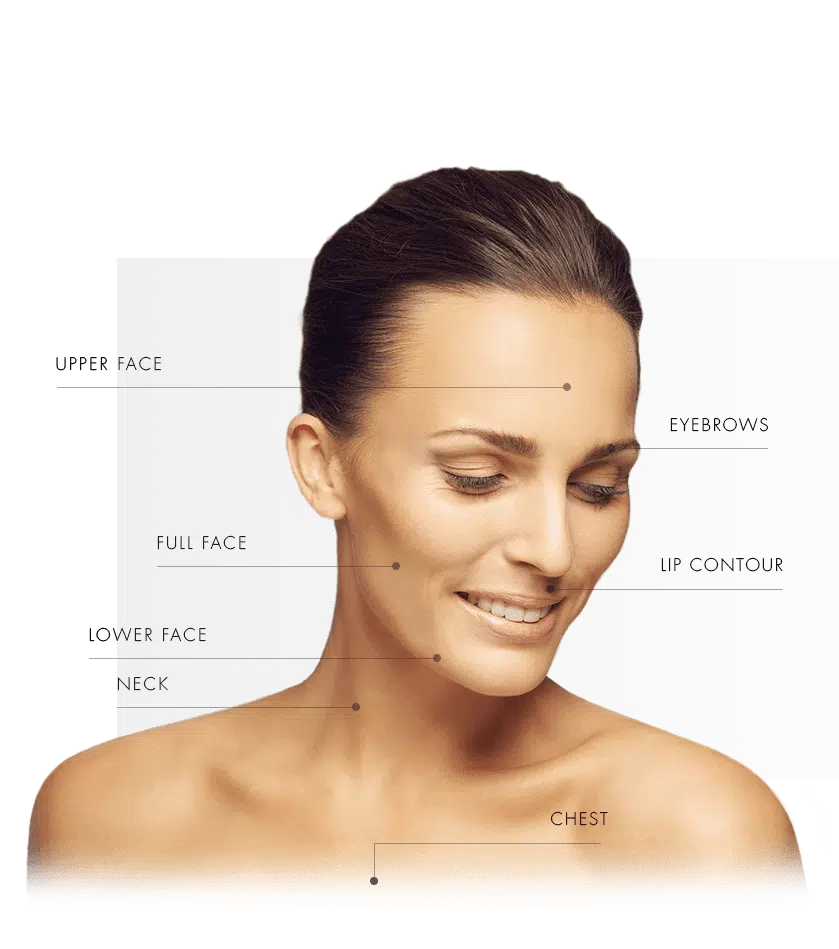
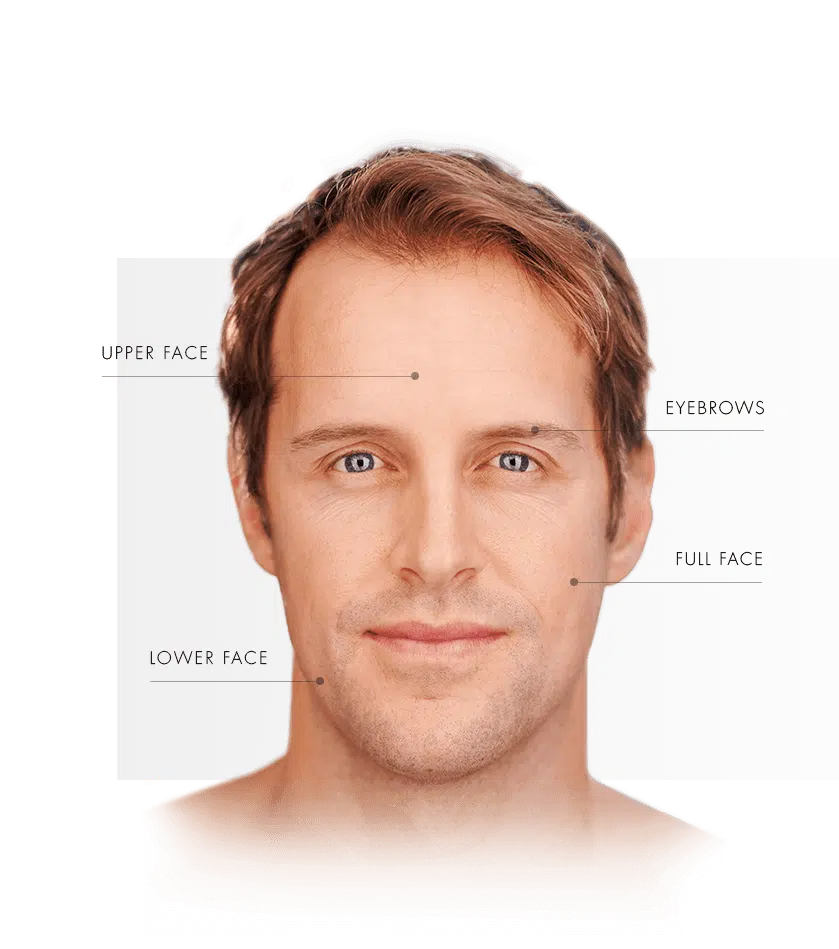
Ultherapy is carried out mostly over the entire face, on eyebrows, neck and chest areas. These areas are most often affected by loss of tone and respond well to ultrasound therapy. Depending on your needs, it is also possible to treat the entire face or just a targeted area of the face; the jawline can be targeted to redefine facial contours, while the eye area can be targeted to lift eyebrows, smooth fine lines and “open-up” the eyes.
Ulthera is normally used in combination with dermal fillers to create a more visible rejuvenating effect. Ultherapy is used to treat sagging skin, while hyaluronic acid injections are used to treat facial hollows.
Identifying one’s level of skin laxity is an essential step in treatments like Ulthera. Its purpose is to determine skin needs and prioritize corrective over preventive measures, as well as to establish your expectations. The current state and age of the skin will affect how it reacts to ultrasound. An individual evaluation will help determine a final diagnosis. We are completely transparent in our approach and only recommend candidates who can truly benefit from this procedure.
After cleansing the skin, the technician uses a specially adapted pencil and ruler to trace a temporary grid over the treatment area. This grid is used as a guide throughout the procedure.
As with all ultrasound devices, a thin layer of ultrasound gel must be applied onto the skin and maintained throughout the procedure to ensure adequate contact. This allows ultrasound waves to penetrate the skin for accurate viewing.
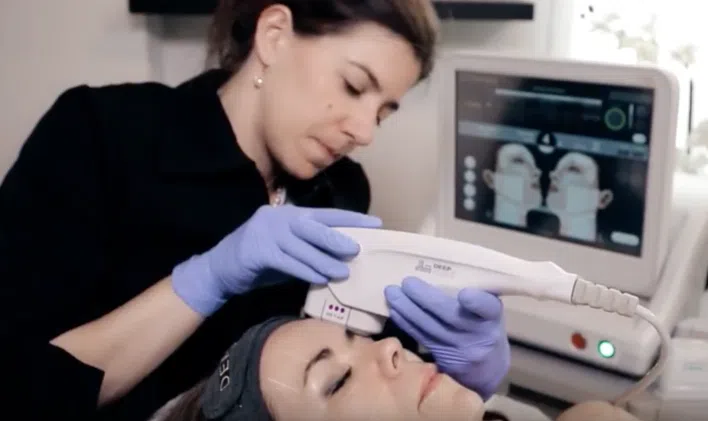
Patented Ulthera DeepSEE technology facilitates the viewing of skin tissue to a depth of 8 mm. A handpiece featuring an ultrasound imaging module is positioned on the skin so the technician can accurately view the subcutaneous layers of the skin for a treatment that is both safe and effective. This echographic examination assesses the depth at which the ultrasound can be performed and highlights problem areas to help the technician avoid the forehead’s frontal bone, manoeuver easily around facial nerves, and treat cheeks close to the bone at a depth of 4.5 mm.
The procedure typically lasts between 30 and 90 minutes—the time needed to produce the energy bursts that stimulate production of new collagen. Guided by the traced-on grid and ultrasound imaging, the technician adapts the treatment to your physiognomy, sometimes focusing on crow’s feet, neck lines, or “jowls”. The intense heat and snapping sensation can make the procedure uncomfortable for some. Patients are advised to take Tylenol or Advil before the procedure.
Treatment prices vary based on your individual needs and the specific procedure performed. To learn more about pricing, we invite you to contact your clinic or schedule a consultation with our experts.
We recommend that an Ulthera treatment be repeated every two years. In addition to strengthening the subcutaneous anchor points, scientific studies show considerable thickening of the skin in the areas treated with micro-focused ultrasonic energy, thereby reversing the natural thinning of the epidermis associated with aging. Ulthera can be alternated with Thermage—Ulthera is a corrective treatment, while Thermage is a preventive treatment.
Also, it is highly recommended to perform 4 treatments of Venus Freeze/Venus Legacy per year to maximize the effects of the radiofrequency therapy throughout the year and thus to continuously stimulate the production of superficial collagen.
Once the desired effects are achieved, the results will last so long as you maintain a healthy lifestyle.
Women who are pregnant or nursing should postpone this procedure.
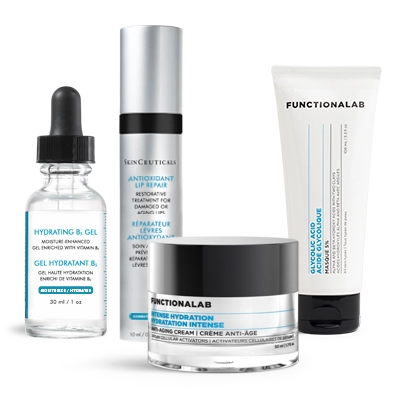
Shop our products for an enhanced beauty routine!
Pricing varies based on the treatment area and your specific goals. A consultation is the best way to receive an accurate quote. On average, prices in Canada range from $750 to $7,500.
A good candidate for Ultherapy is someone with a mild to moderate degree of skin laxity, to the point of looking, and often feeling less firm. Loose skin under the neck and under the chin, or lines and wrinkles on the chest, are signs a patient might be a candidate. The best way to determine if you are a candidate and the recommended treatment to achieve your goals is to book a complimentary consultation, in person or virtually.
For most patients, it is recommended to consider the Ultherapy treatment in your early thirties, when you are starting to experience early signs of aging. As we age, the collagen that keeps our skin firm breaks down. As early as age 25, collagen production slows and results in aging skin, fine lines and wrinkles. Thus, preventative treatments are recommended in order to maintain skin firmness and prevent the signs of aging. This treatment is also recommended for mature skin to obtain a natural lifting effect without surgery or downtime.
Ultherapy is a non-invasive treatment that uses ultrasound energy to lift and tighten loose skin over time, without any downtime. Targeting the deep, structural layers of the skin, Ultherapy uses microfocused ultrasound to generate a thermal effect under the skin. The thermal effect essentially jump-starts your body’s own process that produces new collagen.
Ultherapy treats the deep foundational layer of the skin addressed in cosmetic surgery, but it will not duplicate the results of a surgical procedure. Ultherapy is an effective, non-surgical alternative for lifting and tightening the skin with natural results. Ultherapy may be recommended to maintain surgical results longer.
The Ultherapy appointment can take anywhere from 30 to 90 minutes, depending on the area being treated and the desired results.
Ultherapy can treat face, brows, neck, décolleté are the most frequently treated areas with Ultherapy. The treatment can be customized based on your needs and the desired result.
For most patients, results of an Ulthera treatment appear gradually in the two to six months following a single treatment session and can last for 1-2 years depending on your skin condition and aging process*. It is recommended as part of an annual skin rejuvenation maintenance program.
*Individual results may vary.
Most patients only need one treatment of Ultherapy to obtain desired results; however, some may benefit from more than one treatment, depending on the degree of skin laxity and the body’s unique biological response to the ultrasound and the collagen-building process. Follow-up Ultherapy treatments are recommended each year to help maintain results.
Your personalized treatment plan, carefully prepared by one of our experts, will guide you toward your skin goals.
As the ultrasound energy is delivered, you may feel a short, localized intense hot sensation – tiny amounts of energy being deposited to precise depths, stimulating the collagen-building process. Comfort levels vary from person to person, but the sensation only lasts while the ultrasound energy is being delivered.
There may be slight redness that typically resolves within a few hours following the treatment. Some patients may have slight swelling, tingling, or tenderness to the touch, but these are mild and temporary in nature. Superficial skin dehydration can be observed in the following weeks after treatment.
Most patients return to their regular activities immediately following the Ulthera treatment, although it is possible to experience temporary redness or minor swelling of the treated area in the 24 to 48 hours following the treatment.
Thermage uses radiofrequency energy while Ulthera uses ultrasound energy. Thermage treats more superficial lines and wrinkles on various parts of the face and body and is recommended as a preventive treatment. On the other hand, the corrective action of Ultherapy targets deeper layers of the skin on the face, neck, brow, and décolleté to lift and tighten the treated area. Both treatments are recommended as part of an annual skin rejuvenation maintenance program and can be combined or alternated for optimal results.
It is possible to combine your Ultherapy treatment with injectable treatments. Both neuromodulators and dermal fillers can complement the results of your treatment.
A complimentary consultation with one of our experts will determine your exact skin needs to create your personalized treatment plan and obtain the desired results.
Welcome! Munk MD is now
Dermapure Montreal
Our commitment remains unwavering. Same clinics, doctors, and staff. Step in with confidence; your well-being is our constant dedication
Welcome! Dr.Karen O’Neill Cosmetic Dermatology is now
Dermapure Mississauga Erin Mills
Our commitment remains unwavering. Same clinics, doctors, and staff. Step in with confidence; your well-being is our constant dedication
Welcome! Laser Skin Vein is now
Dermapure Brandon
Our commitment remains unwavering. Same clinics, doctors, and staff. Step in with confidence; your well-being is our constant dedication
Welcome! Ancaster Dermatology is now
Dermapure Ancaster
Our commitment remains unwavering. Same clinics, doctors, and staff. Step in with confidence; your well-being is our constant dedication
Welcome! SKIN Prince George is now
Dermapure Prince George
Our commitment remains unwavering. Same clinics, doctors, and staff. Step in with confidence; your well-being is our constant dedication
Welcome! Skinpossible is now
Dermapure Calgary Chaparral
Our commitment remains unwavering. Same clinics, doctors, and staff. Step in with confidence; your well-being is our constant dedication
Welcome! Longevity Medical is now Dermapure Parksville!
Our commitment remains unwavering. Same clinics, doctors, and staff. Step in with confidence; your well-being is our constant dedication.
Welcome! Dermal Laser Centres is now Dermapure!
Our commitment remains unwavering. Same clinics, doctors, and staff. Step in with confidence; your well-being is our constant dedication.
Welcome! ReNue clinic is now Dermapure!
Our commitment remains unwavering. Same clinics, doctors, and staff. Step in with confidence; your well-being is our constant dedication
Welcome! Rosenthal Clinic is now
Dermapure Victoria
Our commitment remains unwavering. Same clinics, doctors, and staff. Step in with confidence; your well-being is our constant dedication
Welcome! Skinpossible is now
Dermapure Calgary Chaparral
Our commitment remains unwavering. Same clinics, doctors, and staff. Step in with confidence; your well-being is our constant dedication
Welcome! Viva Medical Aesthetics is now
Dermapure Cowichan!
Our commitment remains unwavering. Same clinics, doctors, and staff. Step in with confidence; your well-being is our constant dedication
Welcome! Dr. Boulous Medical Spa is now
Dermapure Newmarket!
Our commitment remains unwavering. Same clinics, doctors, and staff. Step in with confidence; your well-being is our constant dedication
Welcome! Bellissima Medical is now
Dermapure Dieppe!
Our commitment remains unwavering. Same clinics, doctors, and staff. Step in with confidence; your well-being is our constant dedication
Welcome! Peause is now
Dermapure Longueuil-sur-le-parc
Our commitment remains unwavering. Same clinics, doctors, and staff. Step in with confidence; your well-being is our constant dedication
Welcome! RevitalizeMD is now
Dermapure West Edmonton!
Our commitment remains unwavering. Same clinics, doctors, and staff. Step in with confidence; your well-being is our constant dedication